There are no items in your cart
Add More
Add More
| Item Details | Price | ||
|---|---|---|---|

August 19, 2026
Researchers are often taught that a rigorous study begins with a detailed design that specifies the participants, data collection procedures, sampling strategy, and analytic plan before any data are collected. This expectation fits many methodologies, where the design is meant to remain stable throughout the study.
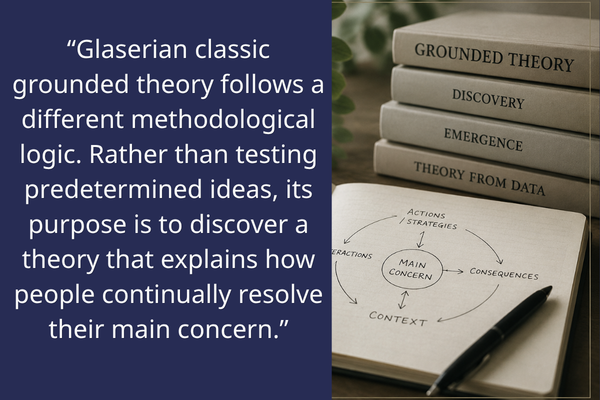
Glaserian classic grounded theory follows a different methodological logic. Rather than testing predetermined ideas, its purpose is to discover a theory that explains how people continually address their main concern. Because that theory has not yet been discovered, many methodological decisions cannot legitimately be made at the outset. They are directed by the emerging theory instead.
This does not mean the study begins without preparation. Researchers identify a substantive (research) area, determine an appropriate point of entry into the field, and commit to the procedures of the methodology, including constant comparison, memoing, coding, and theoretical sampling. As conceptual categories begin to emerge, they guide where the researcher collects data next and what further comparisons are needed. The researcher follows these procedures rather than a predetermined plan.
Researchers unfamiliar with the methodology often interpret this openness as a lack of planning, because they are applying expectations developed for other traditions. In reality, the discipline lies in consistently applying the procedures that allow a theory to emerge without being forced into preconceived explanations, a distinction that is essential to both designing and defending a Glaserian classic grounded theory study.
A doctoral student is preparing a proposal for a Glaserian classic grounded theory study. During the proposal review, she is asked to specify exactly how many participants she will recruit, provide a finalized interview protocol, describe every stage of data collection, and explain how she will know when recruitment is complete.
These questions are understandable, since they reflect expectations common to many research methodologies. But in Glaserian classic grounded theory, several of these decisions cannot be made in advance without departing from the methodology itself. She can describe her substantive area, her point of entry into the field, her procedures for open coding, constant comparison, memoing, and theoretical sampling, and how she will protect participants. What she cannot legitimately specify is her final sample, every source of data, or the precise direction the study will take, because those decisions depend on what the emerging theory reveals.
As data are collected and compared, conceptual categories begin to develop, and those categories direct theoretical sampling by identifying where additional data are needed to elaborate, refine, and saturate the developing theory. Each new comparison informs the next methodological decision, rather than a predetermined sequence of activities.
Faced with institutional expectations for a fixed design, some researchers feel pressure to predict decisions that should remain open, such as specifying a final sample size or a rigid sequence of steps, simply because reviewers expect to see one. Doing so increases the risk of forcing the data rather than allowing categories to emerge through constant comparison.
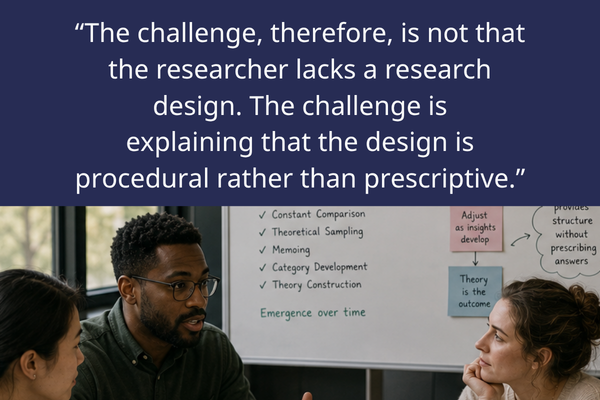
The challenge, therefore, is not that the researcher lacks a research design. The challenge is explaining that the design is procedural rather than prescriptive: it establishes the methodological processes that will be followed while recognizing that many decisions must remain responsive to the developing theory. That responsiveness is not a weakness; it is an essential feature of conducting the study with methodological fidelity.
One of the most common misconceptions about Glaserian classic grounded theory is that because the design is not fully specified in advance, the study lacks structure. In reality, the discipline lies in faithfully applying its procedures while allowing the developing theory to direct subsequent decisions. Researchers new to the methodology often make one or more of the following mistakes:
• Writing a conventional research design that commits to decisions which should remain open. To satisfy institutional expectations, researchers may specify a fixed sample size, predetermined data collection procedures, or a detailed analytic sequence that leaves little room for theoretical sampling, which can unintentionally constrain the emergence of the theory.
• Confusing initial sampling with theoretical sampling. Initial sampling identifies where the researcher will begin collecting data within the substantive area. Theoretical sampling occurs later and is directed by the emerging theory, so it cannot be fully specified before data collection begins.
• Treating theoretical sampling as a strategy for recruiting additional participants. Theoretical sampling is not simply adding more people to the study. It is the purposeful collection of data from additional participants, documents, observations, or other relevant sources to elaborate, refine, and saturate emerging conceptual categories.
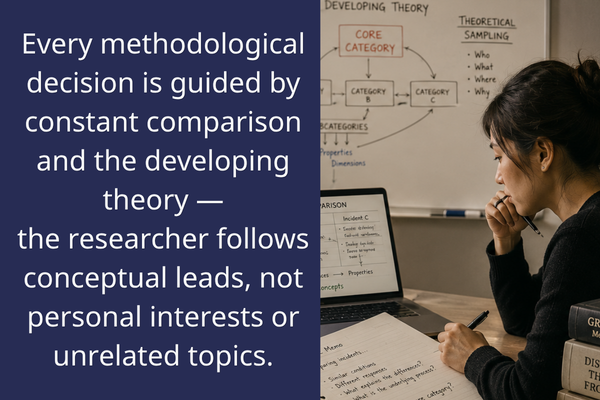
• Assuming that openness means the researcher can simply "follow wherever the data lead." Glaserian classic grounded theory is not an unstructured exploration. Every methodological decision is guided by constant comparison and the developing theory. The researcher follows conceptual leads, not personal interests or unrelated topics.
• Forcing the data to fit preconceived ideas. Entering the study with strong expectations about what the theory should explain, or applying existing concepts too early, can interfere with conceptual emergence. The researcher's task is to remain theoretically sensitive while allowing the data to reveal its own patterns.
• Viewing methodological responsiveness as a lack of rigor. Changing sampling decisions or seeking new sources of data can look like poor planning, but in Glaserian classic grounded theory, these adjustments demonstrate methodological fidelity when they are driven by the emerging theory rather than by convenience.
These mistakes often arise because researchers apply standards from other methodologies to a Glaserian classic grounded theory study. The solution is not to make the study conform to conventional expectations, but to clearly explain the principles that distinguish it from designs that require every decision to be fixed in advance.
Experienced grounded theorists do not view research design as a blueprint that predicts every step. They distinguish between what can be planned before entering the field and what must be discovered through the process itself. This responsiveness is not viewed as changing the research design; it is the expected application of the methodology.
Experienced researchers also recognize the importance of helping reviewers, dissertation committees, and ethics boards understand this logic. Rather than apologizing for what cannot yet be specified, they clearly distinguish between the procedural elements established at the outset and the decisions that appropriately remain open until the emerging theory indicates what is needed next.
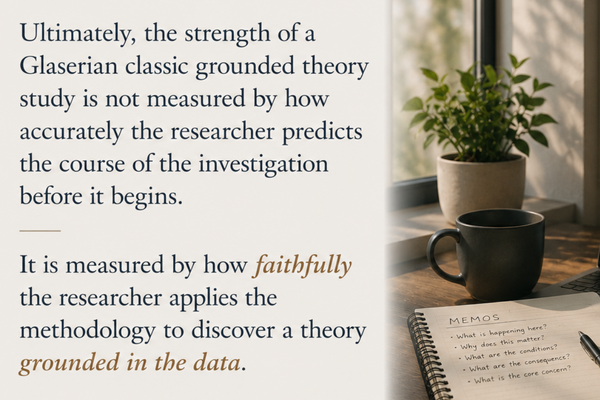
Ultimately, the strength of a Glaserian classic grounded theory study is not measured by how accurately the researcher predicts the course of the investigation before it begins. It is measured by how faithfully the researcher applies the methodology to discover a theory that is grounded in the data.
Designing a Glaserian classic grounded theory study requires a shift in thinking: rather than predicting every methodological decision before data collection begins, researchers prepare to apply a disciplined process that allows the theory to emerge from the data.
• Clearly define your substantive area. Identify the general area of interest without beginning with hypotheses or predetermined explanations. Your proposal can explain why this area is worthy of investigation, not what you expect to discover.
• Describe your initial point of entry into the field. Explain where you will begin collecting data and why that starting point is appropriate. Initial sampling provides a place to begin; it does not determine where the study will ultimately lead.
• Explain the methodological process rather than predicting the outcome. Describe how you will use open coding, constant comparison, memoing, theoretical sampling, and theoretical coding as the study progresses. These procedures provide the methodological structure, even though the conceptual direction is not yet known.
• Distinguish initial sampling from theoretical sampling. Make clear that theoretical sampling cannot be specified in advance because it is directed by the emerging theory. As categories develop, they determine where additional data should be collected to elaborate and saturate the theory.
• Demonstrate theoretical sensitivity. Enter the field prepared to recognize patterns and conceptual relationships without forcing the data into existing theories or personal assumptions. The goal is to conceptualize the patterns that explain how participants continually resolve their main concern, not simply to describe their experiences.
• Write theoretical memos from the beginning of the study. Memoing is the engine of theory development. Record conceptual ideas and relationships among categories. These memos become the foundation for the emerging theory.
• Prepare to explain the methodology to others. Committees, ethics boards, and reviewers may be more familiar with designs that require every decision to be fixed in advance. Clearly distinguishing what is planned from what must remain responsive helps others evaluate your study by the right standard.
Researchers are often surprised to discover that Glaserian classic grounded theory requires considerable planning. The difference is that the planning focuses on faithfully applying the methodology rather than prescribing the path the study will take.
For many researchers, one of the greatest challenges in Glaserian classic grounded theory is becoming comfortable with not knowing where the study will ultimately lead. Academic training often emphasizes certainty, defining variables, specifying procedures, and predicting outcomes before the research begins. This methodology asks something different: to enter the field with methodological discipline while remaining open to discovering what is actually happening.
This openness is not uncertainty about the methodology; it requires confidence in it. As researchers gain experience, their confidence shifts from relying on a detailed plan to trusting their ability to apply constant comparison, memoing, and theoretical sampling with fidelity, allowing each conceptual insight to guide the next stage of the study.
If you find yourself struggling to explain why your research design cannot specify every decision in advance, remember that this is a common challenge for researchers learning Glaserian classic grounded theory. The key is not to defend the methodology as less structured than other approaches, but to explain that its structure lies in the disciplined application of its procedures. Once that distinction is clear, the logic of the methodology and the reasons its research design looks different become much easier for others to understand.
 Launch your Graphy