There are no items in your cart
Add More
Add More
| Item Details | Price | ||
|---|---|---|---|

September 23, 2026
A researcher in one part of the world may begin with a question that seems entirely familiar. Another researcher, thousands of miles away, may approach that same question from a completely different place.
The difference may be cultural.
It may be disciplinary.
It may be methodological.
It may come from the researcher’s relationship with the community being studied—or from a different understanding of what constitutes knowledge in the first place.
What happens when these researchers have an opportunity to hear one another?
We learn.
But learning across traditions requires more than simply putting different researchers in the same room—or on the same screen.
It requires listening.
The word weaving is important in this year’s IC-QRTM theme:
Voices in Community: Weaving Qualitative Inquiry Across Lands & Traditions
Weaving does not mean making every thread identical.
A woven piece has different threads. Each retains something of its character while becoming part of something larger.
That is a useful way to think about a global qualitative research community.
Different traditions do not need to become one tradition.
Different perspectives do not need to reach the same conclusions.
Different researchers do not need to use the same methods.
Instead, we can create opportunities to understand where our approaches converge, where they differ, and what those differences reveal.
We don’t have to agree to learn from one another.
We have to be willing to listen.
Much of our methodological learning happens close to home. We learn the approaches used by our mentors. We read the researchers our field considers important. We attend conferences within our disciplines. We become fluent in the language and assumptions of our research communities. But methodological comfort can sometimes limit methodological curiosity.
Encountering research from another context can make our own assumptions visible.
A researcher may approach community differently.
Another may understand the researcher’s role differently.
Someone else may challenge an assumption about whose knowledge matters.
Another researcher may use a methodological approach that opens up a possibility we had not considered.
These encounters don’t necessarily tell us what we should do. They give us something more valuable: another way of seeing.
“Global” research is sometimes reduced to a list of countries represented at a conference. But geography alone does not create global scholarship. Global scholarship happens when researchers engage seriously with work emerging from places and contexts different from their own.
That means asking questions such as:
· What can I learn from this research that I could not have learned from my own context?
· What assumptions does this researcher make that differ from mine?
· What does this research reveal about the relationship between knowledge and place?
· What might I understand differently if I listened from another perspective?
These are not merely questions about internationalization. They are questions about how knowledge develops.
The same is true of qualitative research traditions.
A global qualitative research community contains different methodological histories, philosophical foundations, research practices, and understandings of inquiry. Bringing these traditions into conversation does not mean pretending that their differences don’t matter. Quite the opposite.
The differences are part of what makes the conversation valuable.
When we understand another tradition more carefully, we may better understand our own. When we encounter a different way of approaching a research problem, we may become more precise about why we approach it the way we do. And when we listen to researchers whose assumptions differ from our own, we may discover questions we had never thought to ask.
For the third year, ic-QRTM will use its month-long YouTube conference format to create space for this kind of global exchange. During October, researchers from around the world will share their work through recorded presentations that can be explored throughout the month.
You can choose presentations that are close to your own research interests.
But you can also choose something unfamiliar.
Follow a researcher from another part of the world.
Explore a methodological tradition you don’t know well.
Listen to a perspective outside your discipline.
Give yourself permission to be surprised.
Because the value of a global research community isn’t simply that we can tell others about our work.
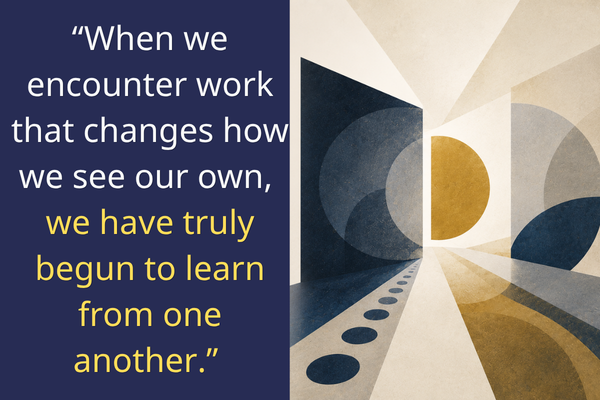
It is that we can encounter work that changes how we see our own.
The 2026 ic-QRTM theme asks us to think beyond the idea of qualitative research as a single conversation.
There are many conversations.
Many traditions.
Many places.
Many voices.
The opportunity is to bring those threads together without losing what makes each one meaningful.
Voices in Community: Weaving Qualitative Inquiry Across Lands & Traditions.
Thirty days.
Researchers from around the world.
A global community ready to listen.
 Launch your Graphy